JOB POSTINGS – CURRENT on UNDERWATERJOBS.COM
By CADC Admin ~ January 20th, 2022. Filed under: JOBS.



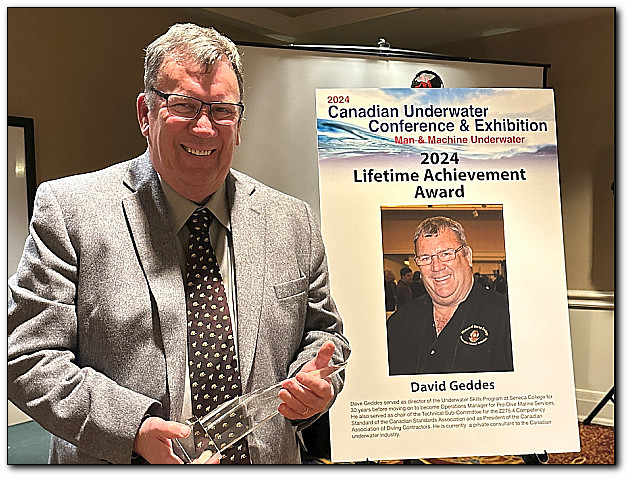
The recipient of this year’s DCBC Lifetime Achievement Award is Dave Geddes, recognizing his outstanding contributions to the Canadian Occupational Diving industry. With a career beginning in the early 1980s, Geddes has profoundly influenced the field through his leadership roles, including over 30 years as the director of Seneca College’s Underwater Skills Course and his active involvement in the CSA Dive Standards. As the subcommittee chair for the Z275.4 Competency Standard and a former president of the Canadian Association of Diving Contractors, Geddes has been a pivotal figure in advancing diving safety, education, and competency standards. His dedication and expertise have not only earned him the CSA Award of Merit but also solidified his status as a key advocate and recognized expert in diving safety and education. This award is a testament to Dave’s enduring impact and his significant contributions to the industry.
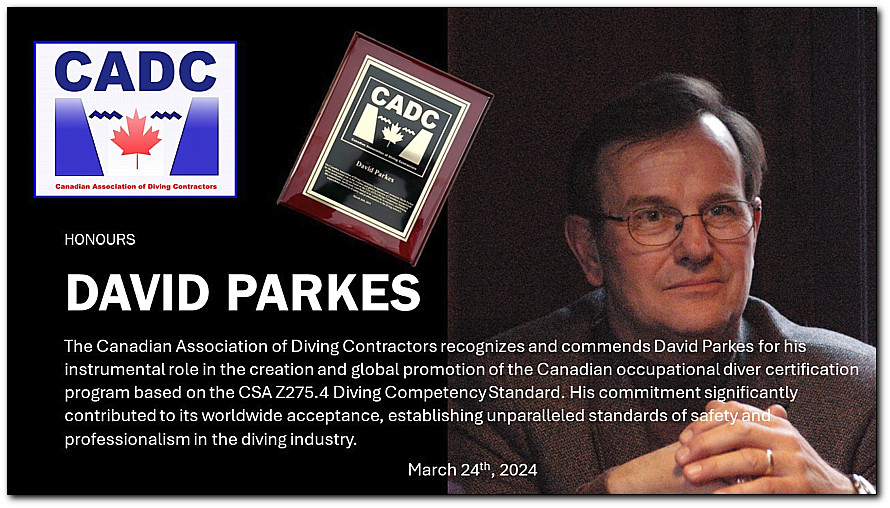
At the Canadian Underwater Conference and Exhibition held in Toronto March 23-26, the Canadian Association of Diving Contractors honoured David Parkes for his work at the Divers Certification Board of Canada.
It seems to be a great time to be a diver! From the past year, all we have heard from the dive and marine contractors are “Where are the divers?” There is definitely a shortage of qualified and competent personnel in the industry right now. In fact, it has been that all year. There is a LOT of work out there right now and will continue into the new year.
The commercial diving personnel shortage of qualified divers – besides the increased demand for their talents – is also due in part to closure of prominent training programs like Seneca College’s diving program and two facilities in the US. The scarcity of such training facilities significantly contributes to the reduced number of new, skilled divers entering the workforce. These events happened over the last two years, and we are feeling it’s effects now. The limited number of commercial diving schools to take up the slack across the country further exacerbates the issue, restricting the training opportunities available for aspiring divers.
This shortage poses multiple challenges and risks in the industry. As the demand for commercial diving work increases, there is a concern that companies might employ undertrained divers, leading to illegal operations and heightened safety risks, including potentially fatal accidents. The role of commercial divers is critical in various infrastructure projects such as water treatment, facilites maintenance, nuclear facilities, and new underwater construction, means their shortage can have widespread economic and operational impacts. Moreover, the necessity for divers to periodically seek recertification—now potentially requiring relocation due to the closure of local training centers—adds an additional hurdle, possibly deterring individuals from pursuing or continuing careers in commercial diving.
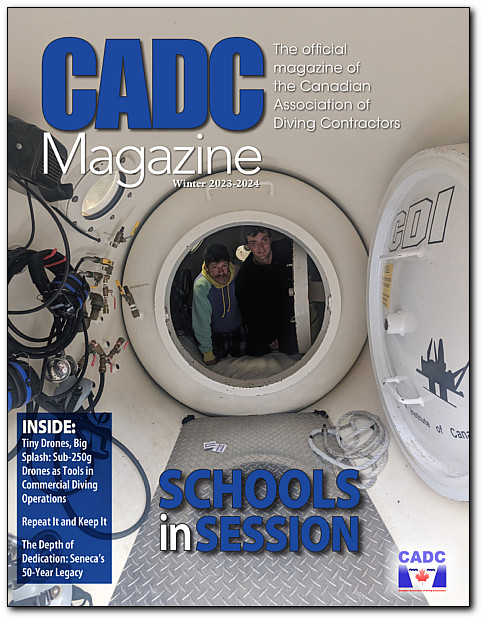
This issue of the CADC magazine showcases the CADC member dive schools who specialize in the skills required to operate both in and outside our borders.
The cover story highlights standout commercial diving schools in Canada. Atlantic Commercial Diving Centre (ACDC) in Prince Edward Island excels in underwater welding and offers state-of-the-art facilities. The Commercial Diving Institute of Canada (CDI), based in British Columbia, is affiliated with heavy civil and offshore sectors, providing internationally recognized training. DiveSafe International, arguabley Canada’s largest dive school, located on Vancouver Island, exceeds CSA and DCBC standards, offering in-ocean training in real-world conditions. Lastly, the Institut Maritime du Québec (IMQ) provides college-level marine sector training, featuring a variety of natural learning environments and state-of-the-art equipment. Each school has unique offerings, contributing significantly to the training of skilled commercial divers.
Our featured CADC member “Expertech Marine,” founded by CADC director Marc-André Désy in 2008, is a one-stop-shop located in Québec City, specializing in underwater operations for port, industrial, and municipal infrastructure. Désy, a former commercial diver turned metallurgical engineer, established the company post-recovery from a severe motorcycle accident. Expertech employs 30 people, including 20 divers, and emphasizes teamwork and a family-like atmosphere. The company’s success is attributed to continuous investment and a strong team. It adheres to CSA standards and actively participates in the Canadian Association of Diving Contractors (CADC), valuing safety, performance, and community connections. Looking ahead, Désy plans to launch Expertech Erosion, focusing on innovative concrete mat solutions for erosion control and environmental restoration.
Sub-250g drones, compact yet powerful, are carving a new niche in operational efficiency and safety. An article by Doug Elsey of the Canadian Association of Diving Contractors, showcases these mini drones that are challenging preconceived notions with their surprising capabilities. From enhancing site surveys to aiding in search and rescue missions, these tiny technological marvels are not just a novelty but a vital tool, reshaping the landscape of underwater operations. As we delve into this story, we explore how these small drones are making a big splash in the commercial diving world by our CADC members.
Brain-dead or just “forgetful”? In a dynamic twist on the world of commercial diving, David Parkes, CEO of the Diver Certification Board of Canada, addresses a pressing issue: the rapid forgetting of crucial skills by dive school graduates. Highlighting the challenges contractors face with newly trained divers, he emphasizes the necessity of repeated practice in using dive tables and maintaining accurate logbooks. This article delves into the critical role of contractors in reinforcing these skills, underscoring the importance of a supportive post-training environment to ensure that the training ‘sticks’, and the diver’s potential isn’t wasted. It’s a tale of skill retention, industry standards, and the journey from classroom to real-world application.
Seneca College’s Underwater Skills Program, a beacon of diving excellence since 1974, faces a transformative chapter. Amidst the shock of its announced closure in 2023, an overwhelming wave of support from the diving community ignited. This support, encompassing petitions, letter campaigns, and strong advocacy, highlighted the program’s profound impact. While the closure decision was upheld, this story is not about an end but a remarkable pivot to resilience and evolution. Embracing a private model, the program prepares to reinvent itself, maintaining its commitment to excellence and shaping the future of professional diver training. Aaron Griffin marks a new era, celebrating 50 years of legacy and heralding a fresh start in diver education. Things are just starting!
It’s important to reflect on the resilience and adaptability our community has shown. The world of commercial diving, much like the oceans we work in, is ever-changing and full of surprises. Despite the challenges we’ve faced, from training shortages to adapting new technologies, our spirit remains unshaken. Our industry’s future is bright, buoyed by the dedication and expertise of each member in this incredible community. As we sail into the new year, let’s carry this momentum forward, continuing to innovate, excel, and above all, ensure the safety and well-being of every diver. To all our members, partners, and friends in the diving world, I extend my heartfelt wishes for a Happy and Safe New Year. Here’s to making a splash in 2024, diving into opportunities with the same courage and determination that defines us. Happy New Year!
Download or read the magazine online: https://magazines.matrixgroupinc.net/cadc/
 This is one of those issues of CADC Magazine that changed its tone in a flash. The Canadian Association of Commercial Divers’ (CADC) very first president, Phil Nuytten, passed away on May 13 after a brief illness. This news was a shock to say the least.
Phil was more than just a past president – he was an icon in our industry. Phil founded the underwater commercial diving and construction company Can-Dive Services in 1965, as well as founded its sister company, Nuytco Research and was one of the original three companies (Can-Dive, Cal- Dive, and Worldwide Divers) that formed Oceaneering International in 1969.
One of Phil’s most notable inventions is the Newtsuit, an Atmospheric Diving Suit (ADS) that preserves an interior pressure at one atmosphere, eliminating the need for decompression. His tributes and rewards for his work could fill a room and includes the Order of Canada. Just google ‘diver Phil Nuytten’ and your computer screen will reveal everything about this truly amazing man. But there is even more to know.
We at CADC, and within our industry, know about all the awards and accolades Phil has received over the years. There is no need to reshare his accomplishments, as many of us have worked for years with Phil in his many endeavours and will mention them in our own tributes to his life. But in the pages of CADC Magazine, we want to give a little insight into what it was like to work with Phil in the trenches of the diving industry. Who was he? What did we see from day to day when things didn’t always go as planned? How do we remember Phil? Our article ‘Remembering Phil’ provides some personal insights of the man behind the glint of his awards – as a diver sees it – through the comments and memories from the guys who worked with him. Divers are a tough crowd in a world where you either make it – or you don’t.
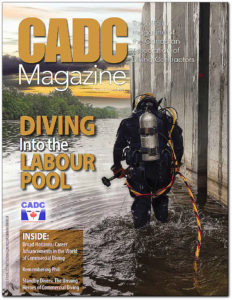
In this issue In the magazine’s cover story, ‘Diving into the Labour Pool,’ we speak with members of the industry about the challenges of finding qualified new recruits and discuss what needs to be done to ensure that the future of this industry is left in good hands. Commercial diving isn’t for everyone but for those willing to embrace it, it’s a job that can take you places.
In the article, ‘Broad Horizons: Career Advancements in the World of Commercial Diving,’ I write about how the commercial diving profession can be a gateway into a lifelong career that is remarkably thrilling and fulfilling beyond all imagination.
In the feature, ‘Standby Divers: The Unsung Heroes of Commercial Diving,’ we learn more about the importance of the standby diver – those willing to jump beneath the waves to help their teammates at a moment’s notice – and why they are just as important today, than ever before.
Founded in 1965, Dominion Divers out of Winnipeg is western Canada’s leading diving contractor. Specializing in underwater construction, maintenance and repairs, salvage, inspections, and underwater surveying services, this issue features Dominion Divers’ long history serving the industry from Manitoba and what might be on the horizon for the company.
In the ‘Safety & Regulations’ update from David Parkes, CEO of the Diver Certification Board of Canada (DCBC), we learn more about CSA’s recent decision to withdraw Z275.5 (containing requirements and performance specifications for occupational diver training facilities and curricula) and its transfer over to the DCBC, which is developing training guidance on how to prepare an individual to achieve those competencies and will make it free for anyone who needs it.
DIRECT LINK TO DIGITAL MAGAZINE: CLICK HERE
ALL MAGAZINES – INCLUDING THIS ONE – FOR DOWNLOAD OR ONLINE READING: CLICK HERE
We are deeply saddened to confirm the passing of Phil on May 13, after a brief illness. Phil’s inspiring life began in Vancouver, British Columbia in 1941 and he was adopted into the Kwakiutl nation. He had a passion for design and started creating diving gear as a young teenager, which led him to open his own dive shop in Western Canada. Over time, Phil’s innovative approach led him to develop equipment
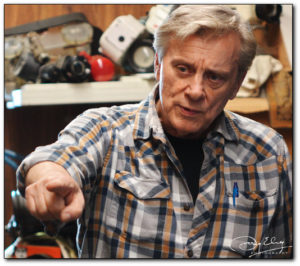 and techniques for commercial, scientific, and military industries. He co-founded Oceaneering International, Inc. in the 1970s and spear headed CanDive Services – a highly regarded and multifaceted commercial diving company.
He gained widespread recognition for his work through media features in outlets such as National Geographic and Time.
Phil’s remarkable design achievements include the invention of the Newtsuit, a one-atmosphere diving suit with fully articulated rotary joints. His invention led to the creation of many subsequent atmospheric diving suits. He was also in the process of developing the Exosuit, a revolutionary ultra-lightweight powered exoskeleton that could have been used as a submarine escape device by the Canadian Department of Defense.
In addition to his groundbreaking work in the diving industry, Phil was also visionary in planning and designing underwater human settlements. He was working on Vent-Base Alpha, a cylindrical living space, powered by hydrothermal vent sources, that was to be built off the coast of Vancouver. A prototype was set to be developed as early as 2019.
Phil received numerous prestigious awards, including induction into the Diving Hall of Fame, the Lowell Thomas award from the Explorers Club in 2000, and appointment to the Order of Canada in 2017. The Diver Certification Board of Canada also presented him with a lifetime achievement award at the Underwater Show, and he was also a founding member and first president of the CADC.
Phil’s incredible legacy will continue to inspire future innovations in the diving industry. His impact on the world of design and exploration cannot be overstated – he will be greatly missed.
 Seneca College – a publicly assisted postsecondary institution – has announced that they will be cancelling their Underwater Skills program. This decision was made WITHOUT stakeholder consultation about this action. Stakeholders include all commercial or occupational diving entities, public service safety divers, educators, military, and regulators.
(From Seneca College website March 29th, 2023) website: “After an incredible 45 years preparing commercial divers for a wide variety of careers both locally and internationally, Seneca has made the difficult decision to cancel the Underwater Skills program. Applications are no longer being accepted into this program.”)
The impact of closing the program – without stakeholder consultation input or as to its impact – has serious repercussions in the industry regarding the training of qualified occupational divers in Ontario – and the Health and Safety issues associated with the training of personnel within the underwater industry in Ontario, nationally and internationally.
Currently the industry is struggling to find (and hire) qualified COMPETENT diving personnel with the skills and experience to necessary conduct safe diving operations in this province. It is a national crisis. It is a regulatory requirement – both provincially and nationally (Bill C-45) – to ensure worker safety by making sure that personnel are competent to a level of diving competence – in our case, it is to the Canadian Standards Associations Z275.4 Diving Competency Standard (with certification of this level of competency by the Diver Certification of Canada (DCBC)) as proof. Regulatory safety inspectors are looking for that certification of compliance and competence. The Seneca College Underwater Skills program provides the training to comply with this standard.
The Ontario MOL has recognized this and in fact, has partnered with Seneca to develop a special training program to identify health and safety issues in the diving industry so they can work safely in compliance to the Ontario Health and Safety regulation. (See attached article CADC Magazine.)
Another serious situation is to diver health and safety in the Public Safety Divers. (Police, Fire, Search and Rescue). Seneca College UWS have been instrumental in the upgrading of the public safety diver training to comply to the diving competency standard (Z275.4) and developed a program to support specific training for a public safety diving program that supported that capability. The Ontario Provincial Police Underwater Search and Recovery Dive Unit is an excellent example of an Ontario Public Safety dive group seeking and continually receiving education for the UWS.
With no stakeholder consultation or lead up to a potential closure by Seneca, they have left little to no time to plan or find alternative options to continue with critical investigative or public safety response such as drowning investigations, weapon and evidence searches and in water security that some agencies provide to local, Provincial, and federal government within Ontario.
The closure of the program means that the critical requirement of training of diving personnel to meet the demand to attain training to recognized a standard of competency (Z275.4 – Diving Competency) to meet regulatory occupational health and safety criteria , is severely limited in Ontario when in fact there is a critical shortage of personnel in the province who are qualified to do the job in spite of the high a demand for qualified personnel. The training required to meet the demand will not be available. Incidents and accidents will happen due to inadequate training to recognized standards and enforcement by knowledgeable regulators.
The closing of the program also means that the training of MOL inspectors to identify Health and Safety issues in the industry – or the training of our public safety divers – creates a situation where an important branch of public service is in a position that they themselves may not be able to respond with qualified individuals. Both the regulatory authority (MOL Inspectors) and our public safety divers simply may not be qualified or competent to do their job.
Closing the program without consultation with the industry stakeholders appears to be short sighted. The implications for our industry in terms of diver health and safety are tremendous. There is a high demand for qualified people. There is a shortage of people.
Seneca College’s Underwater Skills program is recognized worldwide and their input to the development of diving safety standards is acknowledged by the industry as being important and significant. They continue to be a considerable contributor to diver safety development through their active involvement within the CSA Dive Standards group – with leadership roles in all major dive standards committees.
To address the serious concerns for the health, safety, and welfare of personnel within our industry, the MOL, public service agencies and industry must immediately and assertively urge the Seneca Board of Governors to consult with all stakeholders and reassess their decision accordingly.
NOTE: TO SIGN A PETITION TO CONTINUE THIS VITAL PROGRAM, GO TO https://chng.it/2DcmLf98kD
So you want to be a diver?
Many commercial divers have begun their career as a recreational SCUBA diver, and it dawns on them that they might be able to make a career out of it! Others have been in a trade of some type and are looking for a way to carry their skill underwater. Others may have been drawn to it from a movie they saw or in an article where they read it was an exciting career with travel and making a lot of money.
So, will you be living the dream? Or will it be – in fact – a nightmare?
At the outset, one thing about a career in commercial diving is that it isn’t for everyone. As glamorous as the career may seem to be, the reality is quite different. Yes, there is travel. Yes, there is excitement and adventure. Yes, there is an opportunity to make money.
In the recreational SCUBA world, time spent underwater is usually an activity that’s under your control, at your chosen time and conditions. In the commercial world, however, the situation in many instances is not under your control. Things happen in the middle of the night at the most inconvenient time. It is not uncommon to be called out to a job during holidays and late at night. Divers are usually called upon to react to an emergency. They are told that it will last a day — maybe a week. But it lasts three months and you only brought one set of underwear. Being in the diving industry is like working in the fire department – you go when you are called and may stay till it is finished. That’s just the way it is.
DOWNLOAD OR VIEW ON LINE HERE!!!
IN THIS ISSUE:
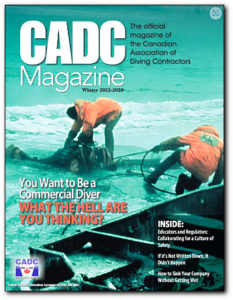
The magazine’s cover story, ‘You Want to Become a Commercial Diver. What the Hell are You Thinking?’ we speak with four commercial divers who made it a lifetime career. See what they had to say. Dream? Or Nightmare?
The turnover at the various provincial Ministries of Labour over the years has resulted in the Ministry losing much of their diving knowledge and skill. Aaron Griffen of Seneca College’s Underwater Skills Program has been working with the Ontario Ministry of Labour over the last year, inviting them out to his dive sites whenever possible to help train up inspectors and give them more hands-on experience as to what it means to be a commercial diver in Canada. His article takes a deep dive into the benefits of maintaining a more collaborative and instructional approach, and what it means for diver safety in the Canadian diving industry and for the members of the Canadian Association of Diving Contractors (CADC).
In the feature, ‘If it’s Not Written Down, It Didn’t Happen: The Importance of Logbooks,’ David Parkes, CEO at the Diver Certification Board of Canada, writes about the importance of keeping your logbooks in order.
‘How to Sink Your Company Without Getting Wet’ – AON is an insurance brokerage that has a significant presence in the area of marine insurance. Brent Chorney at AON emphasizes the need for the commercial diving industry to have a comprehensive insurance policy, and his article covers some of the things that might not first come to mind. If you aren’t covered for an unexpected eventuality – you could sink your company! Read the fine print.
Founded in 1979, Connors Diving Services Ltd is eastern Canada’s premier marine service provider. Connors’ scope of activities has broadened to cover all aspects of commercial diving and marine services, and the company is now one of Canada’s leading in-shore diving companies. This issue features Connors Diving Services’ long history in the industry and what might be on the horizon for the company.
‘All You Need to Know About Filing a Notification of Project’ – Navigating the waters of Ontario’s commercial diving legislation can feel daunting, and there are numerous legal requirements to both understand and adhere to and many of those apply to multiple parties – even for those who may not be in the habit of getting wet. One such requirement is to provide notification to the Ministry of Labour, Immigration, Training, and Skills Development (MLITSD) of the diving operation, prior to its beginning. Matt Neundorf of the MOL explains it all to use.
‘Safety & Regulations’ – In this update from Dave Geddes, CADC President and Chair of the CSA Sub-Committee for the Competency Standard for Diving Operations, Clinical Chamber Operators, and ROV Personnel, he updates readers about the latest on IHSA; WORKSAFE(s); and CSA Dive Standards.
And for those of us who have chosen the diving industry for a career, the smell of aviation fuel and the spinning up of a helicopter about to take off always gets the adrenaline going. We are off to another adventure. Hell, we would not trade it for the world!
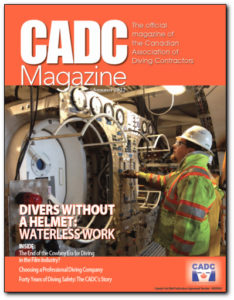 Our undersea industry is exciting, challenging, and full of adventure. That allure is why many of us have chosen it both as a career and a lifestyle. There are so many different opportunities that one doesn’t really have to be a diver in the water to participate. No matter what you’re involved in, this is a rewarding industry to build a career.
One of our feature articles this issue is about the world of underwater filming and how things are improving related to safety and procedures, which haven’t always been a priority. Getting the shot sometimes trumps doing it safely. Is it worth it?
In one segment of my career, I am a professional documentary photographer—much of it underwater. I was on assignment for NATO’s Naval Special Forces—the Deep Diving group of Mine Countermeasures divers—off the coast of Curaçao in the Netherlands Antilles. One particular task was to get a dramatic shot of the divers ascending from a 300 foot dive and get a silhouette of them hanging off the decompression line at 30 feet. They were on rebreathers and I was on SCUBA with a tank I grabbed off the bottle rack. It looked kind of worn, but hey, it contains air! I’m experienced! I can do this!
Seeking the “money” shot, I had been waiting alone— untethered—for about a half hour at 40 feet along the down line and could finally see them ascending out of the darkness. Hanging alone in over 400 feet of black water is very eerie for sure. They passed me and gave me a familiar but friendly one-fingered salute with a chuckle, and continued their ascent to the 30 foot stop. I got busy 10 feet below them and started shooting the silhouette shot and figured I should get one last image at a deeper depth. Down I went another 30 feet into the gloom and looked up. Perfect! Seventy feet. I swung the camera into position and then suddenly felt the “I’m-running-low-on-air!” feeling, with a long sucking draw of air on the inhale! Quick! Get the shot! One shot! Two shots!! Too late!!! Overstayed! I’m running out of air. NOW!
As I drew in a last hard sucking—near panic—inhale, “experience” kicked in with what seemed like a milli-second to spare. I recalled having the same sensation many years ago—you know, that breath you take when you draw down on a J-valve as you run out of air (J-valve being a valve that releases a reserve of air if properly activated). The old tank I had grabbed had a J-valve! With one last effort, I quickly undid the chest strap, did a hard shrug to bring the tank up, and reached as far back as I could to activate the valve. Got it! SSSSSSSSSSSSSSSSSSSSSTTTTTTTTTT was a welcome sound, and I drew a full breath and started heading up. I never said a word to anyone.
“Experience is what you have left after you screw up” resonated in my head. I had screwed up. Another “lucky day,” but I wondered how many I had left. What a helluva career!
Fast forward to today. The feature on page 17, Lights, Camera, Action: The End of the Cowboy Era for Diving in the Film Industry? ponders whether we’re seeing the last of the Wild West, in terms of diving for the film industry, where the importance of “getting the shot” may preclude in doing it safely. Things are changing and responsible production companies are taking safety seriously and using diving practices that follow proper regulations. This article by Aaron Griffin, Seneca College, will focus on how production companies can do things proper and safe. It will also touch on how CADC members are training graduates to work to these standards.
This issues’ cover story, which starts on page 15, is Divers Without a Helmet: Waterless Work. This important article is written for those who are training to be a diver but love the idea of a job in the industry, without getting wet. You can still hone your skills, finish your training, and find a job you’ll love. This article by Richard Engel, ASI Group, will look at the technical requirements of working in this field, from understanding a project’s needs and executing detailed planning, to ensuring the safest processes are in place.
In a “stop-the-presses” kind of way, we realized that in 2022 the CADC has been in existence for 40 years! We celebrate the event in an article on page 23 called CADC – Forty Years of Diving Safety. Make sure to check it out to learn about our colourful past and our accomplishments to date. I’m confident there will be many more to come!
Choosing a Professional Diving Company talks about how an underwater contractor ignorant of current safety standards and regulations can expose the employer to serious (and expensive) civil and criminal liability. Bill C-45 of the Criminal Code of Canada states it is the legal duty of employers and those directing work to take reasonable measures to protect employees and the public, and if not, a company could be charged with criminal negligence. Find out if it’s worth the risk on page 26 (it’s not!), in this article by Doug Elsey, Executive director of the CADC.
We are excited to feature CADC member Canpac Marine Services Inc. in the article Connected Coast: Canpac Marine Services Inc. Based in the Port of Vancouver, Canpac Marine’s focus delivering safe, high-quality, cost-effective solutions for inspection services, repairs, maintenance, and construction of marine assets from surface to 2,000 metres of water depth. Learn more on page 29.
On page 32, David Parkes, CEO of the Diver Certification Board of Canada, talks about the importance of certification to divers, diving companies, and the industry as a whole.
This is just a snapshot of what you’ll find in this edition. Enjoy the read and stay safe!
Both Downloadable PDF and Online viewing are here: CADC – Magazine Summer 2022 HERE!
 Lets start with a little bit of CADC’s colourful history. Our association was formed forty years ago in 1982 when the National Energy Board (NEB), led by Jan Merta, summoned as many Canadian contractors as possible during an Underwater Canada conference in Toronto. He wanted to “chat.”
The scene in the meeting room was reminiscent of the Pirates of the Caribbean movie. All the usual suspects—consisting of most of the major diving companies from across Canada—gathered like a disorganized bunch of saber-rattling renegades and cynical pirates; backs to the wall and trusting no one! This was quite typical at that time.
The message from Merta was quite clear. He advised us that lots of upcoming work off the East Coast and the Arctic was coming, but NONE of us would get any work unless we belonged to an organized commercial diving association. As a representative of the NEB, he himself would not talk to individual contractors who were not part of an organized group. To accomplish this, he offered seed money to organize an association.
In a few months, the non-profit Canadian Association of Diving Contractors (CADC) was formed. Phil Nuytten from Vancouver based Can-Dive Oceaneering was elected the first president and LT-CDR Fred Cox, a retired military diving officer, was chosen to be the group’s first executive director.
The initial membership in the mid 80s hovered between 15 and 20 members. The group was comprised of larger contractors interested in the offshore oil and gas sector in the Arctic and off the East Coast.
In the 90s, advances in computer technology and the growth of the internet changed everything. We could finally reach all the diving contractors across the country. Under the leadership and guidance of accomplished, seasoned industry members serving in the roles of as CADC president, membership grew from that core group of to the present membership of over 70!
In 1999, the NEB announced that they would cease certifying occupational divers and accrediting occupational diver training. They asked industry to set up a replacement certification system that was acceptable to the NEB, the provinces, and the international community. It was decided that the CADC would create a certification agency that was independent and separate from the CADC. This became the Divers Certification Board of Canada and the resulting diver certification scheme based on the diver competency standard CSA Z275.4.
During the evolution of the CADC, a mission statement was developed to guide the organization’s goals: “The Canadian Association of Diving Contractors (CADC) will represent its member’s common interests with regards to safety and environmental standards, client satisfaction, and government intervention within our industry. The CADC will actively promote the use of its members and will supply its members with information and tools to ensure their competence, improve their performance and safety.”
Roughly translated, the CADC is the voice of its members in matters that affect the underwater service industry and forms an umbrella group to act in unison on matters that affect our industry. Its an organization that binds our underwater services members across a vast country; to provide information to our members; to keep them informed; to intervene when they request our help with government issues and matters of safety.
In 2016, the organization voted for member compliance to at least minimum safety standards (CSA Dive Standards) – or better – when there are no standards or regulations in place. This is a condition of membership with the CADC and insures a basic level of acceptable best practices of diver safety. CADC acts on violations of these standards and helps members correct deficiencies. Violations to these standards can be grounds for suspension or termination of CADC membership.
Today, CADC continues to attend CSA Diving Standards and provincial health and safety meetings representing our members. CADC members are in several key positions on these committees. We produce the CADC Magazine to promote our membership to clients and to inform clients on dive safety, regulations, standards, and professionalism required by CADC membership and members. We support a database of qualified divers (via UnderwaterJOBS.com to which CADC has access). We scan job opportunities/tenders for CADC members and alert them weekly on what may be of interest to them. We provide an industry mailing list for instant communication among members. We act in the best interest of our membership and the industry, directed by our Board of Directors, who are voted in by our members to represent them. We are the collective voice that keeps our industry members informed, safe, efficient, and professional.
So, how have we done over the years?
In all, we simply strive to make our industry professional, ethical, and safe – and workable.
The CADC is not about individual companies; it is about a group striving for professionalism in an industry. Para-phrasing a famous quote, “Ask not what your association can do for you. Ask what you can do for the association” – this is about the sum, not the parts.
Why is our association important to our industry? Simply, our association looks after the best interests of its members for a professional, safe, and workable industry – with its members controlling what those interests are or should be.
For over 40 years, we have been doing this. The underwater services industry we work in today has significantly been influenced by our organization and its members. We have a voice within it. We will continue to do this into the future.
Not bad for a bunch of renegade pirates who met in 1982 and forged a relationship to work together today! A success story for sure! Lives have been saved.
(Pre-Release of Article in the Summer CADC magazine.)
 UnderwaterINDUSTRY News